

The relationships we have in life can be split into two categories: parallel and intersecting.
Please note: This is just one framework for thinking about relationships. It is not meant to be treated as a strict binary, but simply another lens to look through that could offer a helpful perspective.
A parallel relationship is one where you simply coexist with the other person. Your lines do not cross. You have a relationship with each other defined by the fact that you are heading in the same direction, but you never step over that line. Examples of healthy parallel relationships include your waitstaff, mechanic, barber, or cashier. For brief periods you are in proximity to each other heading in the same direction, but you don’t invest in each other meaningfully. There’s nothing wrong with parallel relationships in the right context.
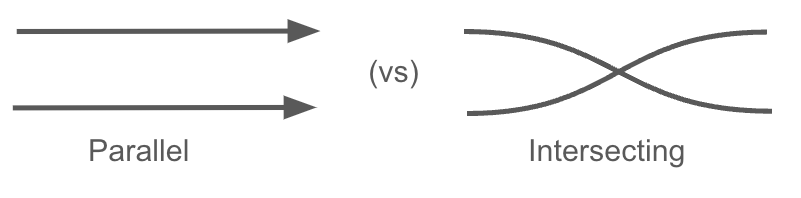
Intersecting relationships are the ones where your lines cross and intertwine. These are people that you care about and who care about you. You take a long-term interest in their life, and they in yours, and you speak into their life with their best interests in mind. Good examples of intersecting relationships include your partner, parents, siblings, nieces, nephews, and friends. The most significant and life-changing relationships you will have will be intersecting relationships.
It can be devastating when an intersecting relationship regresses into a parallel one. This is commonly a friend, family member, or partner from whom we’ve grown apart and who no longer invests in us or has our best interests at heart. Losing connection with people we used to care about, or perhaps still do, is a painful reality of life. That being said, many times when a relationship has regressed, it’s because we have taken it for granted. All it needs is a renewed investment from us to revitalize and transform it into something stronger and more beautiful.
This is plain to see in two of the most common, and most complicated, relationships we encounter in our lives:
- The parent/child relationship. In this relationship, the child should evolve from being the sole recipient of relational investment to investing in the relationship themselves as they enter adulthood. If a child makes these investments as they mature, and the parent continues to reciprocate, the relationship will continue to transform and thrive. But it will regress if the parent or adult-child ceases to invest.
- The romantic relationship. In this relationship, both partners are expected to invest in the other from the outset and to hold each other’s best interests at heart. When relational investments are made and reciprocated the relationship thrives. But if one or both partners start to take the other for granted, and stop putting in the work and investment, the relationship quickly begins to suffer.
We all have intersecting relationships that we can’t live without. These relationships are our support system. They are the people we do life with, the people we “ride or die” alongside. It’s hard to imagine losing any of these relationships, but it happens. And that is where I hope, this framework can be as useful for you as it has been for me. Use it as a relationship audit. Ask yourself “Which intersecting relationships in my life am I treating as parallel?” or, said another way, “Who am I taking for granted?”.
If you’re honest with yourself, this question will always point you toward someone in your life who deserves an investment from you.
Go out there and make it rain.
 MW
MW 