
What do we really take with us as we travel through time? Things like houses, cars, and our belongings are, for all intents and purposes, consumables. They are temporary, replaceable, inanimate, and largely unimportant in the grand scheme. What about relationships? Do relationships travel with us through time? Not really. Relationships are fundamentally external to us, and all but the very best have expiration dates. I would suggest that the only thing we, as individuals, really take with us through time is the information stored in our person. In our body and mind.
Our body and mind store all of the information that we get to take with us through time. They keep records of where we’ve been, what we’ve learned, and how we’ve felt. But these records are incomplete. We can only take so much information with us and it degrades over time, for better and for worse. The Venn diagram below shows one way to visualize this idea.
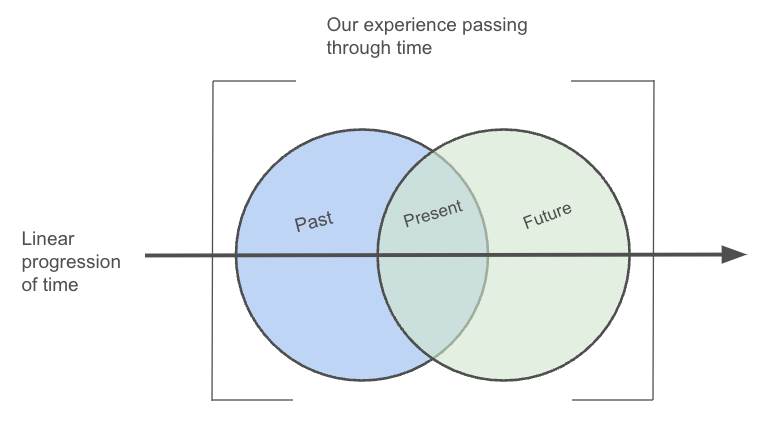
The overlap at the center of the diagram is the totality of the information we have at any one moment in time, made up of what we’ve taken with us from the past, what we have in the present, and what we theorize about the future.
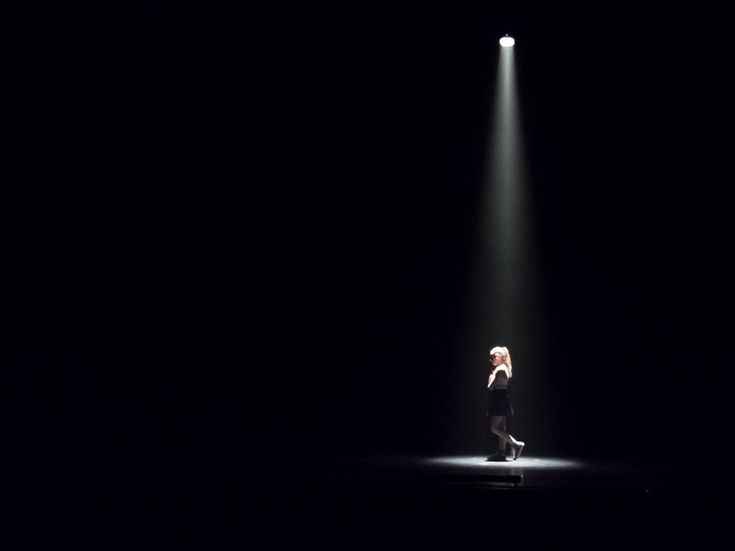
We’re like an actor illuminated by a spotlight on a dark stage. All is black except what the light allows us to see: a small way into the past and an even smaller way into the future. The spotlight represents the information that is available to us in the present. The information we have about the past is fluid. It changes, loses fidelity as the spotlight moves across the stage, and eventually fades to black. The information we have about the future is fluid too and even more slippery. It’s hard to grasp because we have to interpret a sea of variables to come up with an idea of what may take place. Our predictions about the future are rarely correct.
The fact that our information is limited and fades over time is not all bad. It is thanks to the degradation of information that time heals all wounds. With time, the information we retain from a wounding event changes and loses resolution. Our memory reshapes the experience. Softening the edges and fading harsh details into the background. We start to lose some of the experience altogether. We would be crushed if all of our trauma events were perfectly preserved in our minds forever.
Unfortunately, the opposite is also true. If time heals the bad, it also obscures the good. We forget how good the good experiences felt. We forget some of the lessons that we learned. If we aren’t careful, our past – what we retain of it – can transform into a monotone, neutral, non-event. We forget the highs and the lows and the lessons. Crucially, it is precisely this information that gives our lives color, substance, and wisdom.
So how do we address this deficit? What do we do about the fact that time is eating away at our information, experience, and wisdom?
I think it begins with intentionality. Be intentional about the information you choose to bring with you through time. Don’t let the information you once possessed and valued slip away. Perhaps start a journal and document the events in your life that you want to protect from time, how those events made you feel, and what you learned. Review those journals regularly. It doesn’t have to be written, maybe you record videos or audio notes or perhaps you take pictures or create art. Whatever your method, the point is to preserve information, to preserve your experience and wisdom, through documentation.
Time wants to take everything we have. As long as we’re here, it’s our job to fight back.
DO NOT GO GENTLE INTO THAT GOOD NIGHT
by Dylan Thomas
Do not go gentle into that good night,
Old age should burn and rave at close of day;
Rage, rage against the dying of the light.
Though wise men at their end know dark is right,
Because their words had forked no lightning they
Do not go gentle into that good night.
Good men, the last wave by, crying how bright
Their frail deeds might have danced in a green bay,
Rage, rage against the dying of the light.
Wild men who caught and sang the sun in flight,
And learn, too late, they grieved it on its way,
Do not go gentle into that good night.
Grave men, near death, who see with blinding sight
Blind eyes could blaze like meteors and be gay,
Rage, rage against the dying of the light.
And you, my father, there on the sad height,
Curse, bless, me now with your fierce tears, I pray.
Do not go gentle into that good night.
Rage, rage against the dying of the light.
 MW
MW 