
I came across a poster last year that caught my eye. It’s a recruitment poster, used by the British in 1915, to recruit men into the Army. The poster shows an image of a German zeppelin over London, and underneath the words “It is far better to face the bullets than to be killed at home by a bomb. Join the army at once & help to stop an air raid. God save the King.”
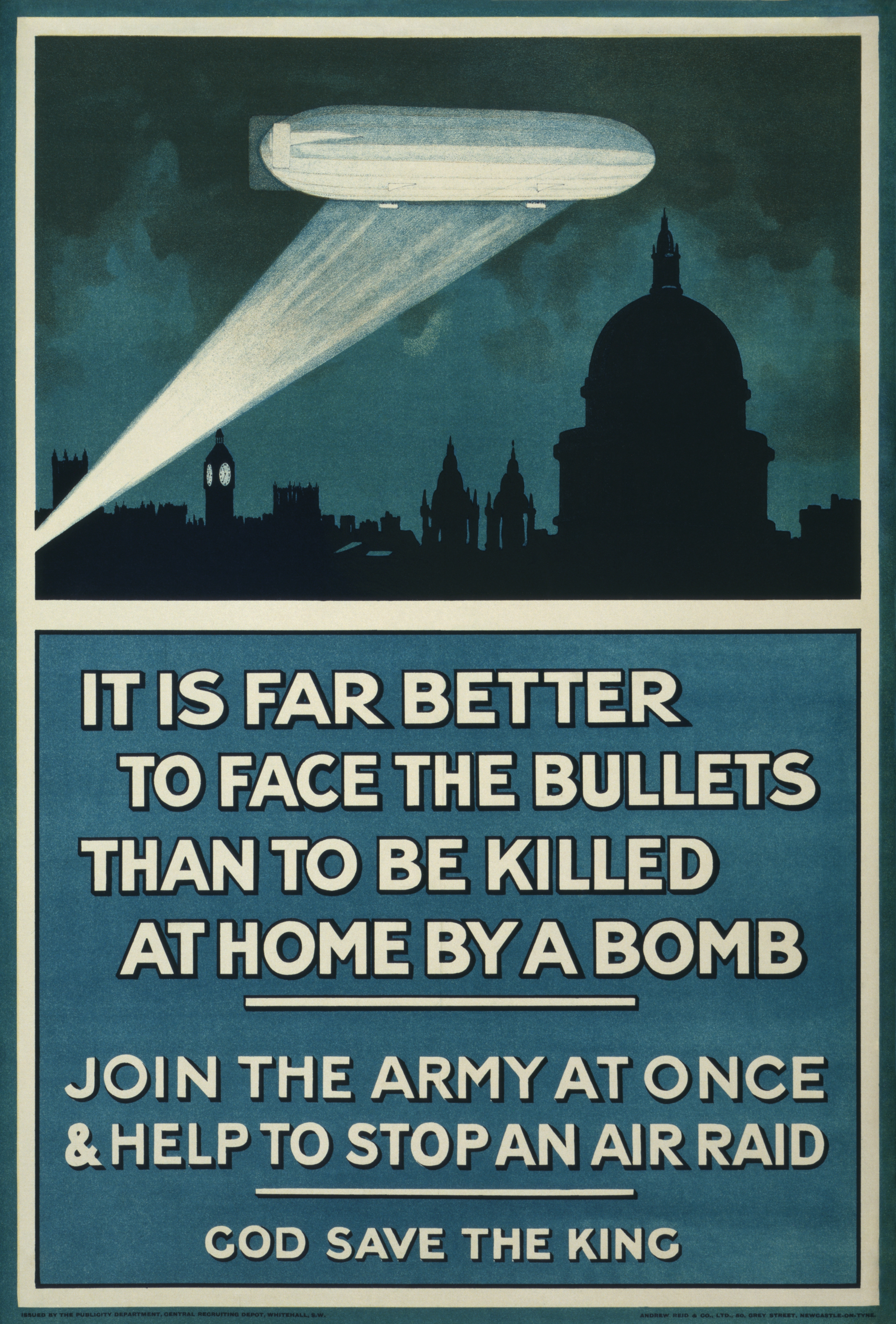
I did a little digging, and it turns out the poster is actually referencing a specific bombing that took place in 1915…
“As London settled into sleep on May 31, 1915, a monstrous airborne machine blotted out the stars of the British night. Using the glow of the River Thames as a guide, the biggest flying vessel ever constructed droned over the city. As a trap door opened from underneath the futuristic 650-foot-long craft, German troops sent 90 incendiary bombs and 30 grenades plummeting from the dark menace. London rattled. Explosions illuminated the night. Panic tore through the city….dawn arrived with seven dead and 35 wounded.” (https://bit.ly/2yu1Hkd)
Imagine being in London the first time it was ever bombed from the sky. Terrifying. The bombing was a violent transition to a new normal (sound familiar?) – a new version of warfare, that now included long-distance threats from above.
I have a copy of this poster on my wall and as I’ve stared at it over the last few months I’ve come to realize; it is not what it seems. In fact, I’ve come to view it as a warning; a reminder to keep both eyes open.
Fair warning: this is a long piece for a blog post. Probably should have been an essay. So no hard feelings if you decide to leave at this point.
For those of you who’ve decided to gut this out, thanks! Let’s dive in. First, a breakdown of the poster for easier reference:
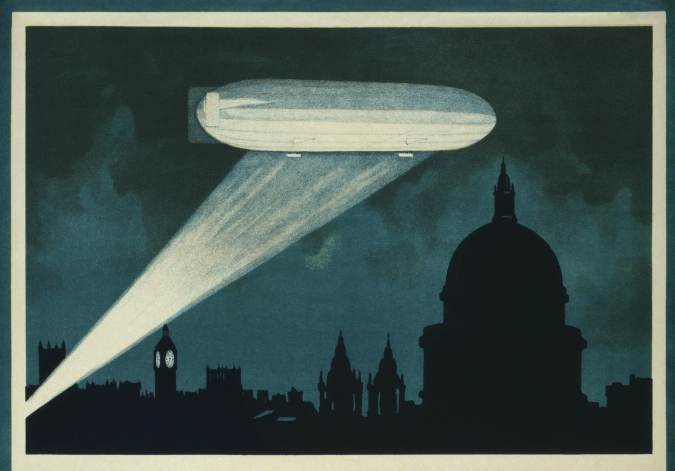
Part 1: the image.
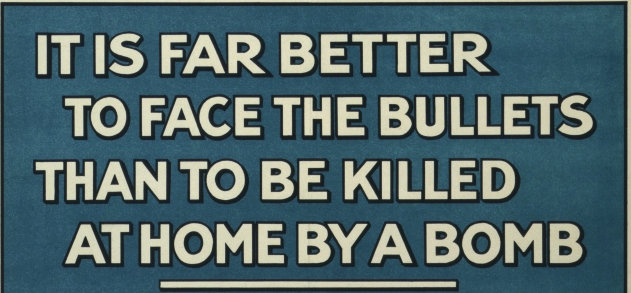
Part 2: “IT IS FAR BETTER TO FACE THE BULLETS THAN TO BE KILLED AT HOME BY A BOMB”
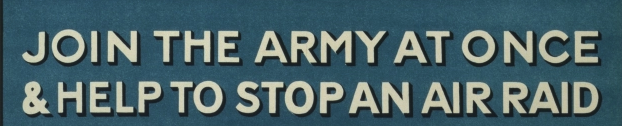
Part 3: “JOIN THE ARMY AT ONCE & HELP TO STOP AN AIR RAID”
Part 4 “GOD SAVE THE KING.”

On its face, this seems like a simple poster with a simple message: tackle your problems head-on! Don’t wait for trouble to find you! The Army needs your help!
But I believe that what’s actually being communicated here is much more complex and, in fact, deceptive.
Part 1: An image of a zeppelin over London.
The poster uses a picture designed to evoke an emotional response: the bombing of London. Londoners felt helpless and vulnerable in the aftermath of the bombing. They were fearful. The poster evokes those emotions by depicting a zeppelin above the city.
It’s analogous to modern-day US recruiters using footage of 9/11 to enlist 18 year-olds in the early 2000s. For those who lived through September 11th, 2001, that footage is very emotionally charged. And putting it in front of a hormonal teen is a sure way to get a recruit.
So, we’re starting strong out of the gate, eliciting an immediate emotional response. The poster then presents the reader with a clear place to put those emotions in Parts 2 and 3:
Part 2: IT IS FAR BETTER TO FACE THE BULLETS THAN TO BE KILLED AT HOME BY A BOMB
Again, the message here seems simple. It’s not. The problem is that it deliberately (and I would argue deceptively) conflates the good of the individual with the good of the state. And it’s hoping you won’t notice. It’s saying that it is better for the reader to face the bullets. Really? That’s clearly false. It was better for the state if the reader chose to face the bullets because the state needed more soldiers, but it would have been better for the reader to stay home. Especially since the odds of getting killed by a bomb in London were quite low.
To be clear, the lens I’m attempting to use here is that of the individual. I’m interested in looking at the question: what was more likely to keep the individual, reading this poster in 1915, alive: facing the bullets, or staying home? And the answer is obvious. The individual would have the best chance of staying alive if he were to stay home.
Now you might say “if nobody enlisted, the British would have lost the war, putting the security of all individuals in jeopardy.” And you’d be right. In order to fight the war, and to keep everyone safe, the British government needed to recruit soldiers. Fair enough. But, if you’ll indulge me, put that out of your mind for now.
You may also say that in a time of war, when the country is under imminent physical threat, young and healthy people have an obligation to their elderly neighbors to enlist and to fight. For the purposes of the point I’m trying to make, I grant that as well. I’ll circle back to these points at the end.
The question this poster begs, at least the question I’m aiming at, has to do with the relationship between government and the individual and how we ought to navigate our relationships to power.
Part 3: JOIN THE ARMY AT ONCE & HELP TO STOP AN AIR RAID
So now you’re being told that not only is it in your best interest to face the bullets but by facing the bullets you will stop the very thing that is terrifying your friends and family; an air raid. Of course, there is no certainty that any individual who enlisted would be anywhere near the efforts to stop the bombings. In fact, it was very unlikely, given that the bulk of the effort was spent abroad.
This poster really sets ‘em up and knocks ‘em down. First the emotional manipulation from Part 1 (the zeppelin over London), the deception in Part 2 (individual good vs. state good), and now the specious assurance of a resolution in Part 3.
What’s next? Well God, obviously.
Part 4: GOD SAVE THE KING
At this point, the reader has been manipulated into a state of emotion, deceived about who they would be helping if they enlisted, and lied to about what their enlistment would bring about. To cap it all off the reader is told that God and the King approve. Your deity and your monarch approve of this message, they approve of you, and they’re asking you to do the right thing for your family, your countrymen, and your soul: enlist in the Army.
This poster is a symbol of the conflict inherent in the systems that we’ve used to run the world since WWI. When it was published, there wasn’t a soul alive who didn’t know the threats facing the country. Yet, in the midst of this critical situation, in the middle of a war, the government decided to manipulate people instead of appealing to them with the truth. In some room full of serious men in suits, the call was made to talk down to and manipulate people into signing up for war. Did the ends justify the means? They certainly seemed to for the state.
I keep this poster on my wall as a warning. A reminder to distrust certainty when I hear it from my government. It is a stark example that you will not be told the whole truth by your institutions and that it is up to you to think for yourself and to make decisions that are truly in your self-interest. The government is a power structure. And whether consciously or not, it will always take actions that perpetuate itself and its power over you.
At the same time, we are all part of an agreement, a social contract, and we have some level of obligation to each other. When our country is under direct threat, our obligation to each other comes into focus, and many will be asked for selfless acts, whether that is joining the military, or staying home to #stopthespread.
The paradox of government is that it needs us just as we need it. The difference is that the government will never make a selfless choice, but people, on the other hand, will sacrifice themselves for a cause. That’s why this poster is so important.
Only through constant vigilance will we maintain our freedom. We must remember that, even in times of crisis, the government will take advantage of our capacity for selfless acts. Our humanity will be used by those in power to stay in power, at the expense of the people, AND it will be used to protect the people. And if we know these two things at the outset of a crisis, then we can proceed with our eyes wide open. The conflict between the people’s need for the system and the system’s tendency towards self-preservation, at the cost of the people, is a conflict endemic to the structures of power that run our world.
I swear I didn’t write this with the COVID-19 crisis and stay-at-home orders in mind, but what I’ve written here obviously has some applications in the current global context. All I’m going to say is that in this crisis, while we are being asked to give up our liberties, keep your eyes open. The government is not capable of acting selflessly, but we are, and you can bet that we’ll be asked to continue to sacrifice.
I’ll temper the anti-government sentiments with this; I think that the stay-at-home orders were (and still are) necessary AND that we need to figure out how to begin opening the economy in a safe and responsible way, as quickly as possible, AND that we will likely see some form of rolling stay-at-home orders across the globe as health officials try to mitigate risk as we progress towards herd immunity.
We must, at the same time, work within the system to manage the crisis and know that the system is designed to self-perpetuate and maintain its power, the costs of which will be born by the people.
 MW
MW 
One thought on “A Selfless Institution Is An Oxymoron: Read The Fine Print”